
Offsite Construction Isn’t About Being a Better Builder. It’s About Being a Better Manufacturer.

The modular and modern methods of construction (MMC) sector appears trapped in a recurring cycle. Factories open with optimism. Capital flows in. Projects stall. A facility closes. Critics re-emerge. “Proof,” they say, “that homes cannot be built in factories!”
The conclusion is seductive. It is also wrong.
Offsite construction is not an evolution of traditional building. It is the industrialisation of building. And industrialisation obeys a different logic. The difficulty is not that factories cannot produce housing. It is that much of the sector continues to approach manufacturing with the mindset of a contractor or builder.
Traditional construction is organised around projects. Each site is unique. Each client negotiates variation. Margin is calculated per job. Flexibility is considered a virtue. The system tolerates adjustment because adjustment is embedded in the culture.
Manufacturing tolerates no such ambiguity. It is organised around process. Profitability depends on throughput. Standardisation is not a preference but a requirement. Margins are achieved not by renegotiation but by efficiency. Rhythm matters more than improvisation.
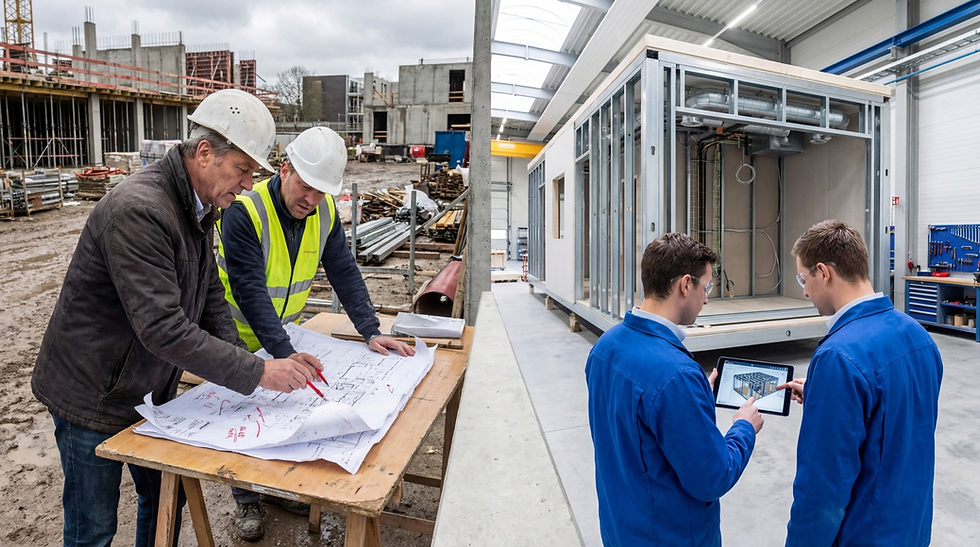
When these two mental models collide inside a factory, friction is inevitable. And so is failure.
Construction Thinking vs Manufacturing Thinking
Traditional construction operates in a project-based world. It is:
Sequential
Site-managed
Trade-coordinated
Variation-tolerant
Margin-per-job focused
Each build is its own event. Each site has its own conditions. Each client introduces its own adjustments. Flexibility is part of the culture.
Manufacturing is different. It is:
Process-based
Throughput-driven
Standardisation-led
Variation-averse
Cost-per-unit disciplined
Margin-through-efficiency focused
A factory cannot thrive on improvisation. It survives on rhythm, repeatability, and predictable flow. When people approach offsite construction with a traditional building mindset, friction is inevitable. Because a factory does not operate like a building site.
Offsite construction is not an evolution of building. It is the industrialisation of building.
The Core Shift: From Project to Product
The most important shift in offsite construction is the move from project to product. A project is fluid. A product is defined. A project accommodates late change. A product requires design freeze. A project absorbs variation. A product limits it.
Without defined specifications, repeatable detailing and engineered tolerances, a factory loses its advantage. If every client redesigns the output, the line stops being industrial and reverts to bespoke assembly at higher cost.
This is where many offsite ventures falter. Builders establish factories but continue to operate as if each order were a conventional site build. Sales teams promise flexibility. Contracts mirror traditional risk structures. Production sequencing becomes secondary to client variation. The result is predictable: throughput weakens, fixed costs remain, margins erode.
In traditional construction, every building is a project. In manufacturing, every building must become a product. That shift changes everything. A product requires:
Defined SKUs
Controlled specifications
Repeatable detailing
Strict design freeze
Engineered tolerances
Planned production sequencing
If every client redesigns the layout mid-production, the factory loses its economic advantage. If specifications drift, throughput collapses. If variation dominates, efficiency disappears. The power of offsite construction lies in product discipline. Not project improvisation.
A factory does not survive on optimism. It survives on cadence.
The industrial principle is straightforward. High fixed costs demand predictable demand. Predictable demand requires secured pipeline. Secured pipeline requires product clarity. Product clarity requires discipline.
The automotive sector does not pause its assembly lines to redesign their chassis. Electronics manufacturers do not alter production mid-cycle because a buyer requests a new configuration. Industrial systems reward front-end engineering and punish mid-stream alteration.

“We’ll Make the Product. You Assemble It.” This is the mental shift the industry must accept.
Why So Many Offsite Ventures Struggle
The failures we’ve seen are not proof that factories don’t work. They are proof of something else:
Builders attempted to operate factories like construction sites.
Facilities were capitalised without secured pipeline.
Product platforms were not standardised.
Sales teams promised bespoke variation.
Contracts mirrored traditional construction risk allocation.
You cannot run a factory on construction logic. A factory lives and dies on:
Throughput
Fixed cost absorption
Production rhythm
Predictable demand
Miss those fundamentals, and the economics unravel quickly. Industrial manufacturing is unforgiving. It exposes inefficiency immediately.
This Is Not About Replacing Trades
None of this diminishes the role of the trades. Electricians, plumbers and project managers remain essential. What changes is the environment in which they operate. Work moves from reactive coordination on site to controlled execution within a production system. That is not a reduction in skill; it is a shift in setting. It represents professionalisation rather than displacement.
The emerging model is not one in which builders simply “build faster.” It is one in which manufacturers produce repeatable housing platforms and builders assemble engineered systems on prepared sites. Developers secure programmatic pipeline rather than one-off commissions. Capital is structured around factory economics rather than project cash flow cycles. Governments align procurement with industrial delivery rather than fragmented contracting.

In short, the debate about whether modular works misses the point. The relevant question is whether it is being operated as manufacturing. If offsite construction continues to be treated as an innovative branch of traditional building, volatility will persist. If it is governed as industrial production, with the discipline that entails, stability follows.
The real conversation should not be: “Does modular work?”
It should be: “Are we operating it like a manufacturer?”
That distinction changes everything.
Author: Terry Gordon - Modular Manufacturing Strategist


Comments